Reconquista History
The word "Reconquista" was invented in the nineteenth century to describe events that medieval participants would not have recognised as a single coherent project. For 781 years, Christian kingdoms, Muslim taifas, and Jewish communities on the Iberian peninsula fought, traded, intermarried, allied, and betrayed one another in patterns of extraordinary complexity — and the simplified narrative of Christian reconquest obscures almost all of it. This hub page is the authoritative English-language resource that treats this complexity honestly. It connects every piece of Reconquista content on the site into a coherent whole — an interconnected resource that Google will recognise as topically authoritative and that readers will return to as a reference.
Background: What Was the Reconquista?
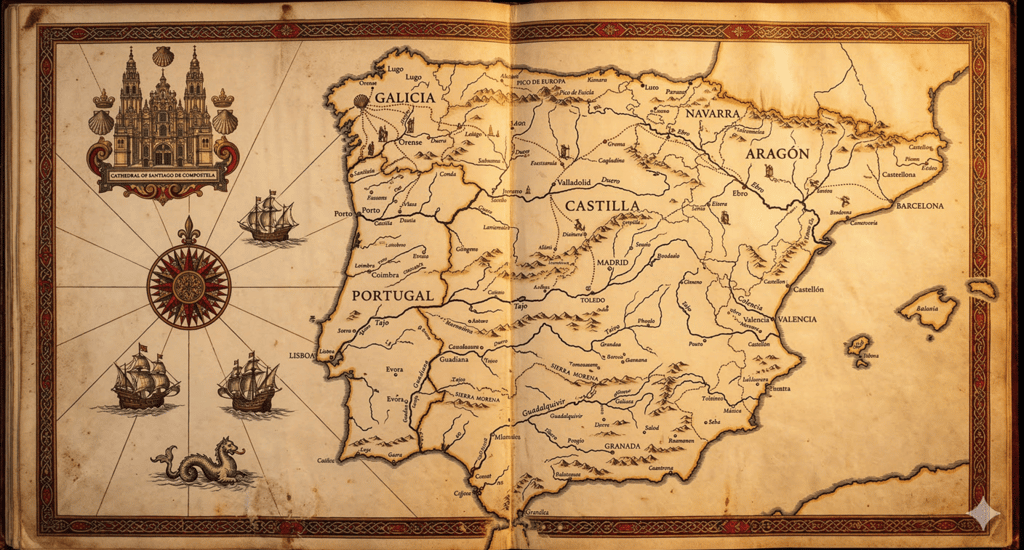
The Reconquista ("Reconquest") was the roughly 800-year effort by Christian kingdoms in northern Iberia to reclaim territory from the Muslim rulers — the Moors — who had swept across the peninsula beginning in 711 AD. It concluded with the fall of Granada in 1492, the same year Columbus sailed for the Americas. It wasn't a single sustained military campaign but rather centuries of shifting borders, alliances, truces, and warfare between a patchwork of Christian kingdoms and Muslim taifas (principalities).
St. James as a War Banner
The cult of St. James became extraordinarily useful to Christian rulers as a unifying ideological force. The legendary figure of Santiago Matamoros — St. James the Moor-slayer — depicted the apostle as a warrior on a white horse, sword raised, cutting down Muslim enemies on the battlefield. This image first appeared in accounts of the Battle of Clavijo (844 AD), where Christian forces supposedly saw St. James appear miraculously in the sky and turn the tide against the Moors. Historians today believe Clavijo was either greatly embellished or largely invented, but that hardly mattered at the time — the story spread rapidly and became a cornerstone of Christian martial identity in Iberia.
The Santiago Matamoros iconography was deliberately powerful. It fused the sacred and the military, telling Christian soldiers that God's own apostle was literally fighting alongside them. Rallying cries of "Santiago y cierra España!" ("St. James and strike for Spain!") were used in battle for centuries.
The Tomb as a Political Anchor
The timing of the tomb's "discovery" around 830 AD was remarkably convenient. The Christian kingdoms of the north were under enormous pressure — militarily, politically, and psychologically — from the sophisticated and powerful Umayyad Emirate to the south. Having a major apostolic shrine on Iberian soil gave the Christian kingdoms something Rome and Constantinople couldn't offer: a direct, physical, local connection to the apostolic era. It told Christians that God had specifically chosen Iberia as sacred ground, lending divine legitimacy to their struggle.
King Alfonso II, who ordered the first church built over the tomb, understood this perfectly. Santiago de Compostela quickly became not just a religious site but a statement of Christian permanence and identity in a contested land.
Pilgrimage Routes as Strategic Infrastructure
The roads that developed along the Camino were not merely spiritual pathways — they were arteries of Christian civilization. As the Reconquista pushed southward over centuries, the pilgrimage routes helped consolidate Christian control over newly won territory. Towns grew along the routes, populated partly by settlers encouraged to move into depopulated frontier zones. Monasteries along the way served as centers of agricultural development, literacy, and political loyalty to Christian crowns. The French Way, in particular, was actively promoted by the Kingdom of Navarre and later Castile as a way to attract settlers and economic activity to northern Spain.
The military-religious orders — like the Order of Santiago, founded in the 12th century — explicitly tied knighthood and pilgrimage devotion together. Members of the Order of Santiago vowed to protect pilgrims and fight the Moors, blurring the line between pilgrim and crusader almost entirely.
The Crusading Connection
The Camino was also deeply entangled with the broader Crusading movement. Pope Urban II, who launched the First Crusade in 1095, had visited Santiago de Compostela the previous year. The papacy consistently framed the Reconquista as a crusade equivalent to fighting in the Holy Land — pilgrims to Santiago and fighters against the Moors were seen as participants in the same spiritual struggle. This meant that walking the Camino wasn't just personal piety; it was an act of solidarity with a civilization-wide Christian project.
A Complicated Legacy
It's worth noting that the historical reality of Reconquista-era Iberia was far more nuanced than the crusading mythology suggests. Christians, Muslims, and Jews lived side by side for long periods, often in genuine coexistence (convivencia), and alliances frequently crossed religious lines. The Santiago Matamoros image is today a deeply contested symbol — celebrated by some as part of Spain's heritage and criticized by others as a representation of religious violence. Several churches in Spain and Latin America have quietly replaced or recontextualized the image in recent decades.
What remains undeniable is that the Camino and the Reconquista fed each other for centuries — the pilgrimage lending spiritual energy and political legitimacy to the Christian kingdoms, and the military successes of those kingdoms expanding the safe territory through which pilgrims could travel. By the time the Reconquista ended in 1492, the Camino had helped shape the cultural and political identity of what would soon become a unified Spain.
Key Sites of the Reconquista (711–1492)
Pivotal cities and landmarks from the 800-year Reconquista — from the Christian strongholds of the north to the final Muslim kingdom of Granada in the south. Each location marks a critical chapter in the struggle that shaped medieval Iberia.
Santiago de Compostela — Spiritual Heart of the Reconquista
Tomb of St. James, patron saint of Spain. The pilgrimage here fused spiritual devotion with Christian military identity. Battle cry: 'Santiago y cierra España!'
León Cathedral — Kingdom of León
Capital of one of the oldest Christian kingdoms. León was a major power in the early Reconquista, eventually merging with Castile in 1230.
Burgos Cathedral — Heart of Castile
Capital of the Kingdom of Castile and home of El Cid (Rodrigo Díaz de Vivar), the legendary Christian military hero. Castile became the dominant Reconquista power.
Aljafería Palace — Zaragoza
Built as an Islamic palace (1065–1081). Captured by Alfonso I of Aragon in 1118 — a major Reconquista victory in the northeast. Later became the palace of the Catholic Monarchs.
Toledo — The Contested Capital
Captured from the Moors by Alfonso VI of Castile in 1085 — one of the most significant Reconquista victories. A city of Christians, Muslims, and Jews living side by side.
Mosque-Cathedral of Córdoba
Capital of the Umayyad Caliphate — the most powerful and sophisticated state in 10th-century Europe. Recaptured by Ferdinand III of Castile in 1236. The Mezquita-Cathedral embodies the cultural layering of the era.
Seville Cathedral — Almohad Stronghold
A major Almohad capital. Captured by Ferdinand III in 1248. Built on the site of the great Almohad mosque; its famous Giralda tower was originally a minaret.
Alhambra, Granada — Last Moorish Kingdom
4.8(154,223)·Museum
The last Muslim stronghold in Iberia. Granada fell to Ferdinand and Isabella on January 2, 1492 — ending 781 years of Muslim rule and completing the Reconquista.
Key Sites of the Reconquista (711–1492)
A map of pivotal cities and landmarks from the 800-year Reconquista — from the Christian strongholds of the north to the final Muslim kingdom of Granada in the south. Each location marks a critical chapter in the struggle that shaped medieval Iberia.
Santiago de Compostela — Spiritual Heart of the Reconquista
4.7(83,939)
León Cathedral — Kingdom of León
4.7(37,088)
Burgos Cathedral — Heart of Castile
4.8(38,479)
Aljafería Palace — Zaragoza
4.6(31,191)
Toledo — The Contested Capital
4.8(184)
Mosque-Cathedral of Córdoba
4.8(28,525)
Seville Cathedral — Almohad Stronghold
4.8(57,283)
Alhambra, Granada — Last Moorish Kingdom
4.8(154,223)
Here's an interactive map of 8 key sites spanning the full arc of the Reconquista — from the Christian strongholds of the north all the way down to the final Muslim kingdom at Granada. Each pin includes historical context about the site's role in the 800-year struggle.
A few highlights to note as you explore:
North to south reflects the general direction of Christian expansion over the centuries
Santiago de Compostela (far northwest) was the spiritual fuel for the whole enterprise
Toledo (center) was the symbolic prize of the mid-Reconquista, a city where the three faiths had long coexisted
The Mosque-Cathedral of Córdoba and the Alhambra are the most powerful physical reminders of what was lost — extraordinary Islamic architecture that Christian rulers chose to preserve rather than destroy, a testament to the complexity of the era